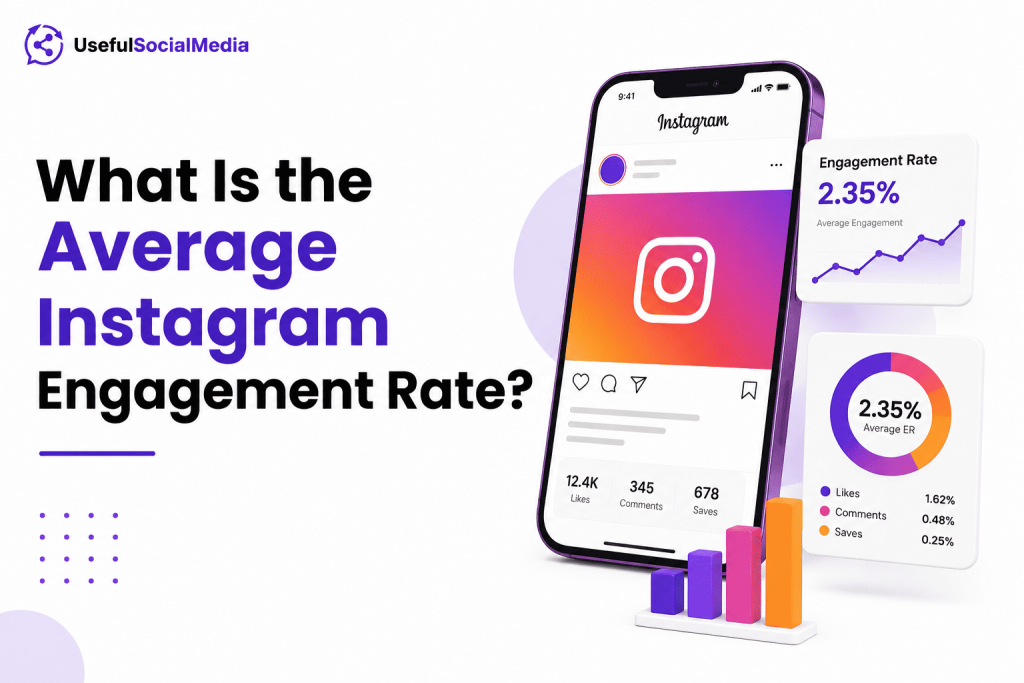
For most brand accounts in 2026, the average Instagram engagement rate is around 0.45% by follower count. In simple terms, that means about 45 people interact with a post for every 10,000 followers.
But the average doesn’t tell the whole story. A 1% engagement rate could be excellent for a large brand, while a smaller niche account may expect much more. The right number depends on who follows you, what you post, and how you measure engagement.
This article breaks down the latest Instagram engagement benchmarks, what a good rate looks like, how to calculate it, and what actually helps to improve it.
What is The Average Instagram Engagement Rate?
For most brand accounts in 2026, the average Instagram engagement rate is about 0.45%. That number has dropped from 0.52% in Q1 2025.
Different reports show slightly different numbers, but they all point to the same thing: Instagram engagement rates are falling.
This is because Instagram now shows users more content from accounts they don’t follow. Meta confirmed this change in an official update.
As a result, your followers are seeing fewer posts from your account than they did a few years ago. The difference in engagement numbers across reports usually comes from how they are calculated.
| Reported figure | Denominator used | Typical source type |
|---|---|---|
| 0.30% – 0.50% | Followers | Most industry studies |
| 1.5% – 2% | Reach | Social media tool reports |
| 3% – 3.5% | Not always disclosed | Aggregated dashboards |
These numbers are not wrong. They are just measuring different things.
Instagram’s audience is still massive, as around half of the US adults use the platform. The challenge isn’t finding people on Instagram. It is getting your content in front of them.
Source: Social Insider, Pew Research
What is a Good Engagement Rate on Instagram?
A good Instagram engagement rate in 2026 usually looks like this:
- Below 0.5%: Below average. Your content strategy may need some changes.
- 0.5% – 1%: Normal for most brand accounts.
- 1% – 3%: Strong. You are performing better than many brands.
- 3%+: Excellent. This is more common among smaller accounts with a highly engaged audience.
But there’s no single number that defines a “good” engagement rate. Instead, It depends on three things: your industry, your follower count, and the type of content you post. A rate that looks average for a large brand could be impressive for a smaller account.
Instagram Engagement Rate by Industry
Some audiences naturally engage more than others. A post about a football match, a student discount, or a charity campaign will usually get far more likes, saves, and shares than a product ad from a retail store or a bank update.
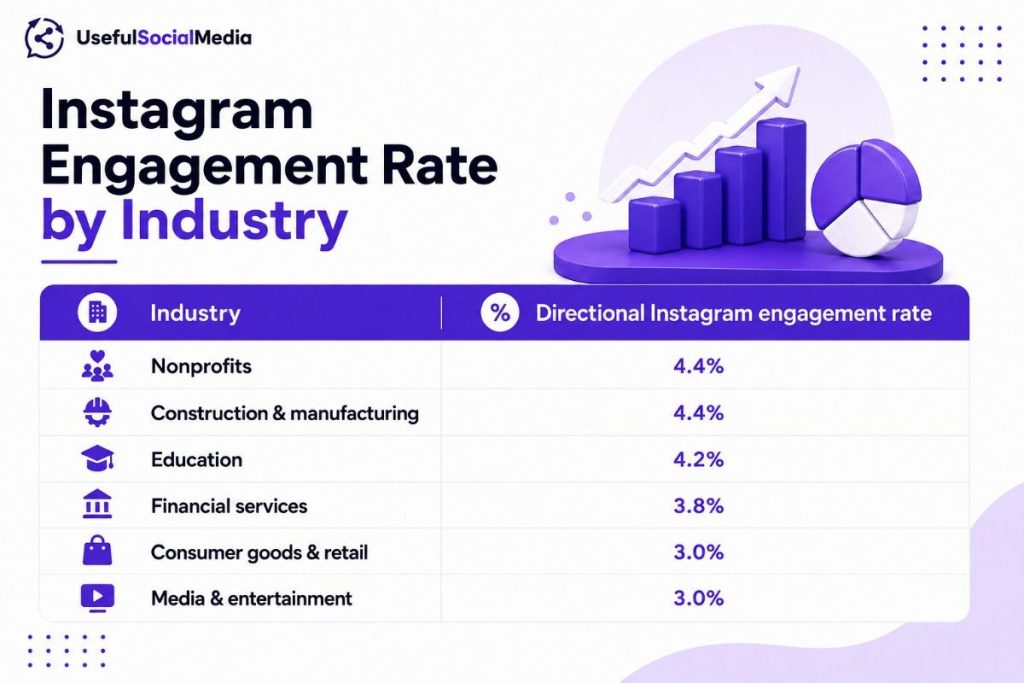
Here’s a general view based on Hootsuite’s 2026 industry benchmark research:
| Industry | Directional Instagram engagement rate |
|---|---|
| Nonprofits | 4.4% |
| Construction & manufacturing | 4.4% |
| Education | 4.2% |
| Financial services | 3.8% |
| Consumer goods & retail | 3.0% |
| Media & entertainment | 3.0% |
These figures are based on reach, not follower count. Use them to understand how industries compare, not as fixed benchmarks. A good engagement rate will still depend on your audience, content, and goal.
Instagram Engagement Rate by Follower Count
Smaller accounts usually have higher engagement rates than larger ones. That is expected because smaller communities tend to be more connected and responsive.
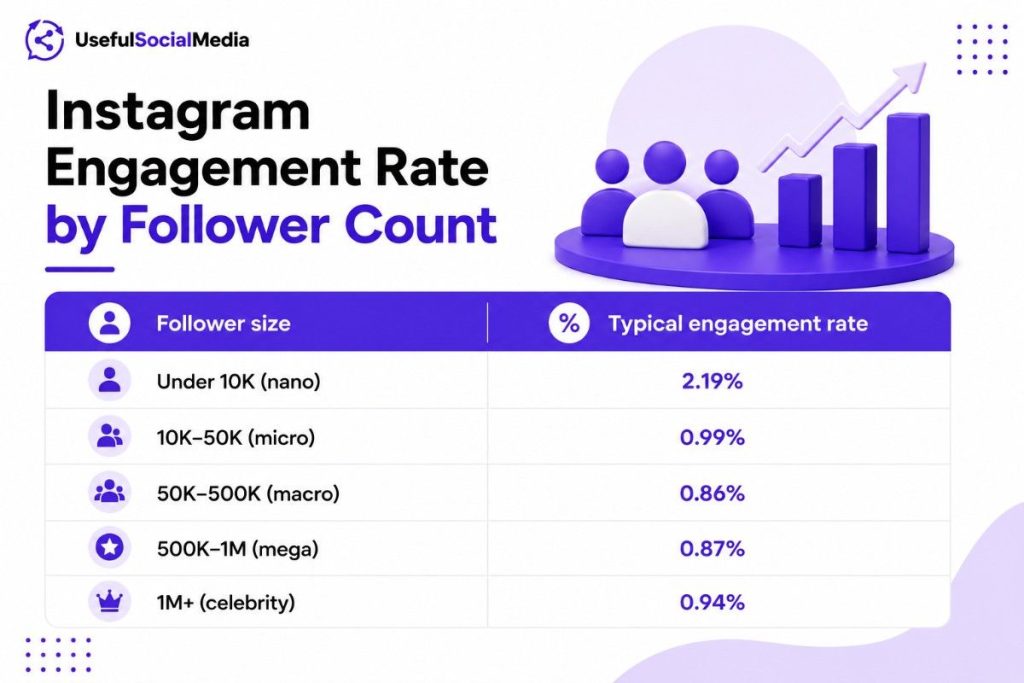
Here’s a pattern showing influencer engagement data:
| Follower size | Typical engagement rate |
|---|---|
| Under 10K (nano) | 2.19% |
| 10K–50K (micro) | 0.99% |
| 50K–500K (macro) | 0.86% |
| 500K-1M (mega) | 0.87% |
| 1M+ (celebrity) | 0.94% |
Source: Statista, Sprout Social
So, a 2,000-follower account getting a 2% engagement rate is normal. It is close to the average for accounts of that size.
A larger account with the same percentage is usually much harder to achieve because engagement tends to drop as follower counts grow.
Average Instagram Engagement Rate for Brands
For brands, the type of content you post can affect engagement more than caption length or the number of hashtags you use.
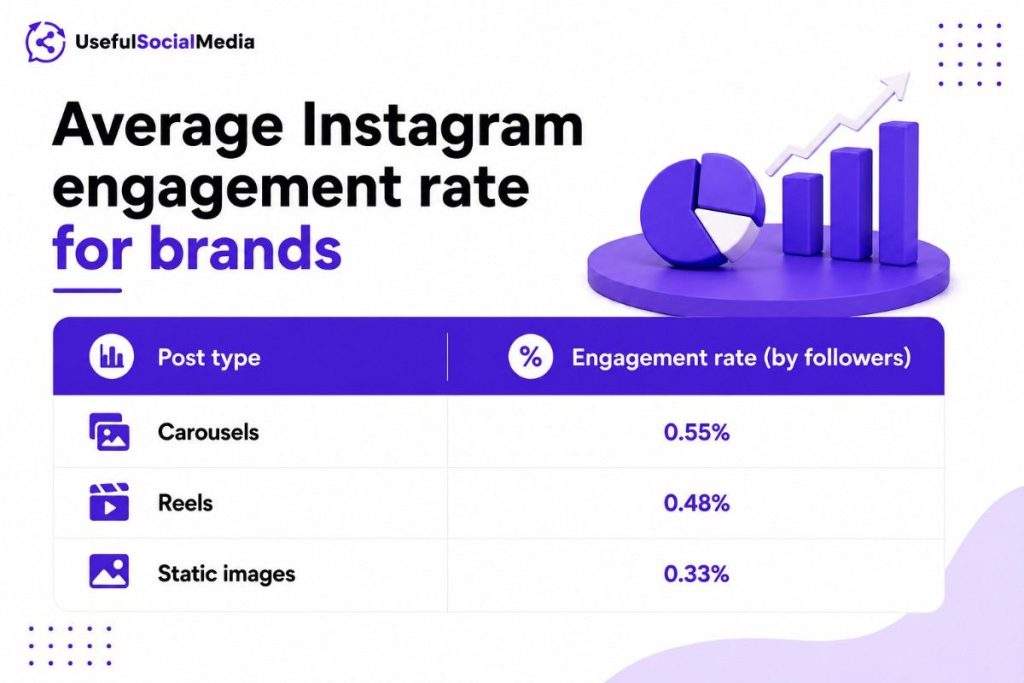
Here’s where average Instagram engagement rates stand by content type.
| Post type | Engagement rate (by followers) | Best for |
|---|---|---|
| Carousels | 0.55% | Saves, comments, and educational content |
| Reels | 0.48% | Reaching people who don’t follow you |
| Static images | 0.33% | Announcements and quick updates |
Carousels often get better brand engagement from existing followers, while Instagram Reels still win on reach because the algorithm pushes them to non-followers. A good mix is to use both. Create carousels for deeper content and use Reels to attract new followers.
Stories and DMs also play an important role. Instagram doesn’t count them in public engagement rates, but Instagram’s own creator guide confirms saves, shares, and Story replies carry heavy algorithmic weight.
How to Calculate Average Instagram Engagement Rate
There are three common ways to calculate Instagram engagement rate. The important thing is to choose one method and use it consistently.
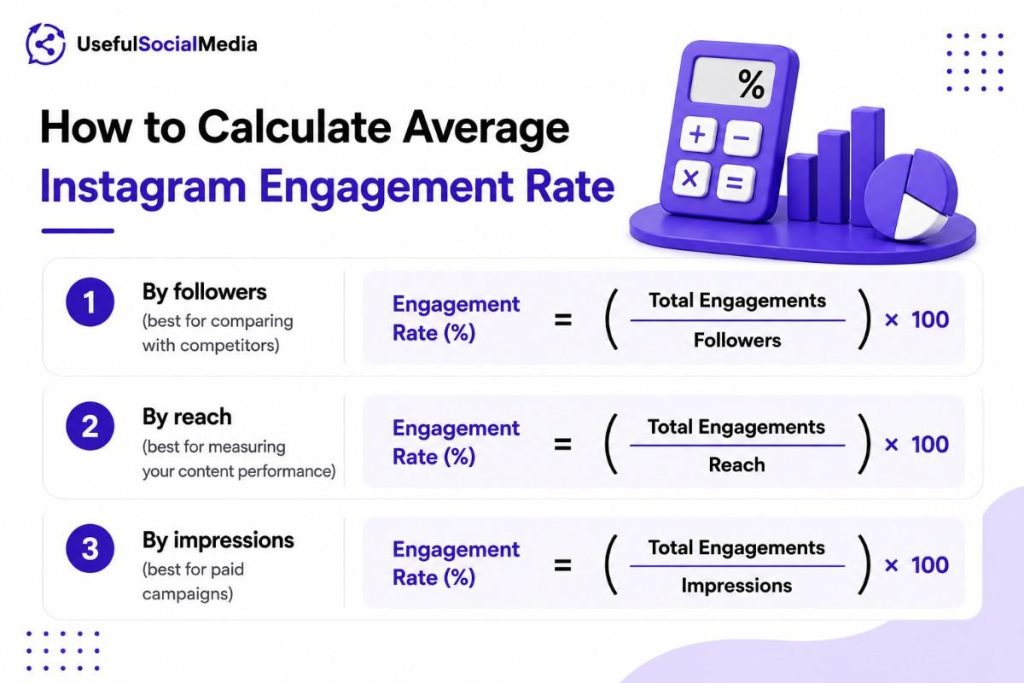
1. By followers (best for comparing with competitors):
(Total Engagements ÷ Followers) × 100
2. By reach (best for measuring your content performance):
(Total Engagements ÷ Reach) × 100
3. By impressions (best for paid campaigns):
(Total Engagements ÷ Impressions) × 100
Here’s a simple example:
You have 5,000 followers. One of your posts gets 40 likes, 9 comments, and 2 saves. That gives you 50 total engagements.
(50 ÷ 5,000) x 100 = 1% engagement rate
The formula is simple. The confusing part is using different formulas without realizing it.
A 1% engagement rate by reach isn’t the same as 1% engagement rate by followers. Comparing the two can give you a completely different view of your performance.
Engagement usually includes likes, comments, saves, and shares. Views alone don’t count. DMs and Story replies are visible in your private Instagram analytics but are not included in most public engagement benchmarks.
How to Check Average Engagement Rate on Instagram
There are two ways to check your average Instagram engagement rate. One is free and built into Instagram. The other saves time if you manage multiple accounts.
Using Instagram Insights
First, make sure you have a Business or Creator account. Then
1. Open your Instagram profile and tap Professional Dashboard or Insights.
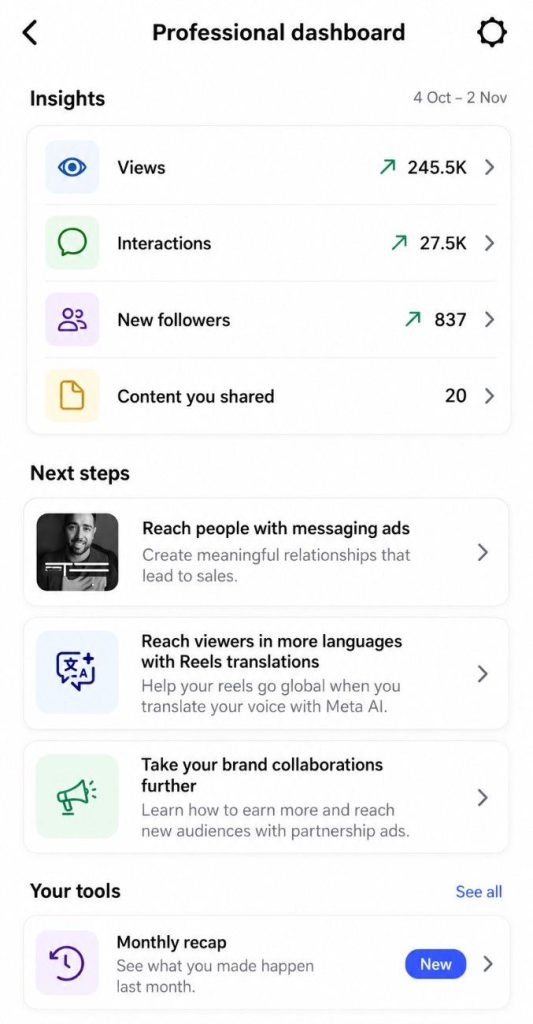
2. Go to Content You Shared and choose a date range.
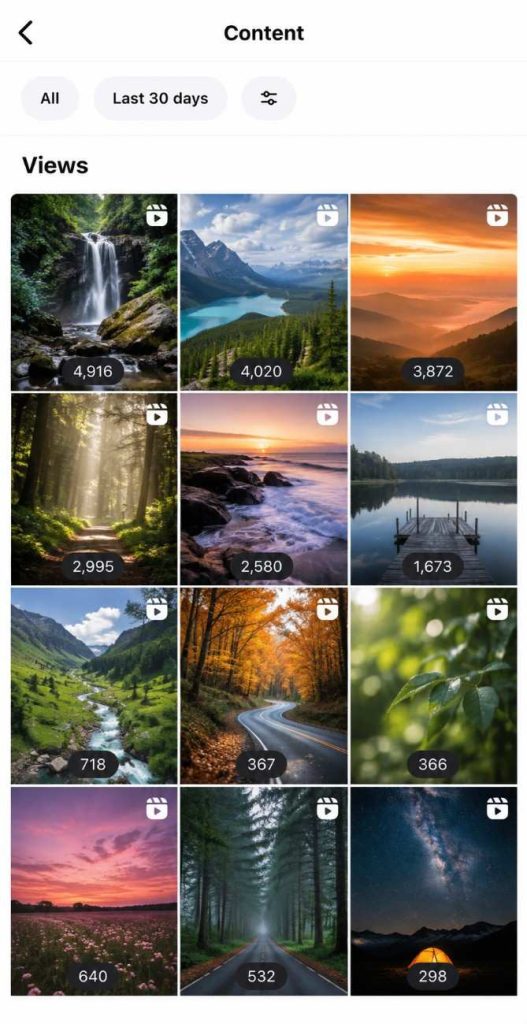
3. Check the total interactions across your posts.
4. Divide the number by your follower count and multiply by 100.
This gives you your average engagement rate by followers for that period.
Using a Third-Party Analytics Tool
Platforms like Buffer, Later, Sprout Social, and Hoosuite can calculate engagement rates automatically. These tools are useful when you manage multiple accounts or need regular reports.
One thing to keep in mind: different tools may use different formulas. If you change tools, your engagement rate may appear to rise or even fall when your actual performance has stayed the same.
How to Improve Your Instagram Engagement Rate
Focus on the points below to improve your Instagram engagement rate.
1. Optimize for saves and shares, not just likes
Likes are easy to get, but saves and shares show that people found your content useful. These actions also send stronger signals about content quality.
2. Use carousels for value-driven posts
Carousels give people more reasons to interact. They work well for guides, tips, step-by-step content, and educational posts.
3. End captions with a simple question
Comments take more effort than likes. A clear question gives people an easy reason to reply.
4. Reply to every comment in the first hour
Early conversations can help build momentum. Stay active in the comments soon after publishing the content.
5. Create Reels consistently
Instead of chasing one viral post, build a regular posting habit. Recording multiple reels in one session can make consistency easier.
6. Share Feed posts to Stories
It gives your existing audience another reason to see and interact with your content without creating something new.
Conclusion: The Average Instagram Engagement Rate is around 0.45% by Followers
Anything above 1% is considered strong. If you are below 0.5%, it may be time to review what is working and what isn’t.
But the most useful comparison is your own performance from three months ago. That benchmark reflects your audience, your calculation method, and your goals.
Choose one formula, track it consistently every month, and pay more attention to saves and shares and not just likes alone.
Remember that your growth over time matters more than any industry average.
FAQs
Yes. A 5% engagement rate is excellent. It is usually achieved by smaller accounts or brands with a highly focused audience.
For a brand account, yes. A 1% engagement rate is considered strong and is above the average for many business accounts.
Common reasons include Instagram showing more content from accounts people don’t follow, changes in how content is recommended, or follower growth happening faster than engagement growth.
Reels usually get more reach because Instagram recommends them to new audiences. But when it comes to engagement from existing followers, carousels can often perform better.
A daily engagement habit: leave 5 comments on other accounts, respond to 3 posts, start 1 direct conversation.