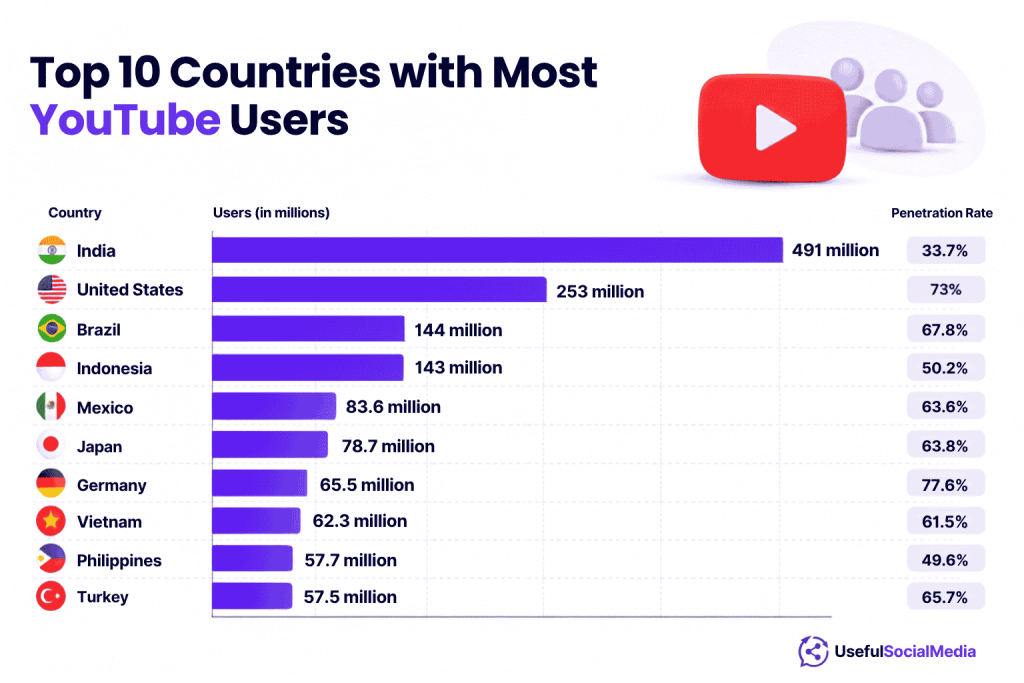
India has the most YouTube users in the world, with roughly 491 million viewers. The United States ranks second at 253 million, and Brazil third at 144 million.
These three markets show where creators and advertisers find their biggest audiences. Our YouTube Users statistics break down which countries fuel that scale and why the numbers matter for anyone planning content or campaigns.
YouTube Users 2026: Key Statistics
- India has the highest number of YouTube users, with about 491 million people actively consuming it.
- YouTube reaches 2.7 billion monthly active users worldwide.
- Germany posts the highest penetration rate on this list at 77.6%.
- More than 30% of YouTube’s users are between 18 and 34 years old.
- Men account for almost 53% of the platform’s audience.
Top 10 Countries with the Most YouTube Users
Here’s a table that lists YouTube users by country. The penetration rate tells you what percentage of each country’s people actually use YouTube.
| Country | Users | Penetration Rate |
|---|---|---|
| India | 491 million | 33.7% |
| United States | 253 million | 73% |
| Brazil | 144 million | 67.8% |
| Indonesia | 143 million | 50.2% |
| Mexico | 83.6 million | 63.6% |
| Japan | 78.7 million | 63.8% |
| Germany | 65.5 million | 77.6% |
| Vietnam | 62.3 million | 61.5% |
| Phillippines | 57.7 million | 49.6% |
| Turkey | 57.5 million | 65.7% |
Source: World Population Review
How Many People Use YouTube?
According to the latest data, about 2.7 billion people use YouTube every month, making it one of the largest and most influential digital platforms.
YouTube remains a leading destination for entertainment, education, news, and discovery, with 55.4% of online adults using the platform monthly and 94.6% watching online video content.
With such a huge reach, YouTube isn’t just a place for viewers. Creators, businesses, and marketers all count on the platform to connect with people around the globe.
Source: Teleprompter, DataReportal
YouTube User Demographics
Knowing who watches matters as much as knowing where they live. This section breaks down the global YouTube audience by age and by gender.
YouTube Users by Age
Among YouTube users worldwide, the 25–34 age group is the largest audience segment, accounting for 21.7% of users, followed closely by the 18–24 age group. Together, viewers under 35 make up more than 30% of YouTube’s audience.
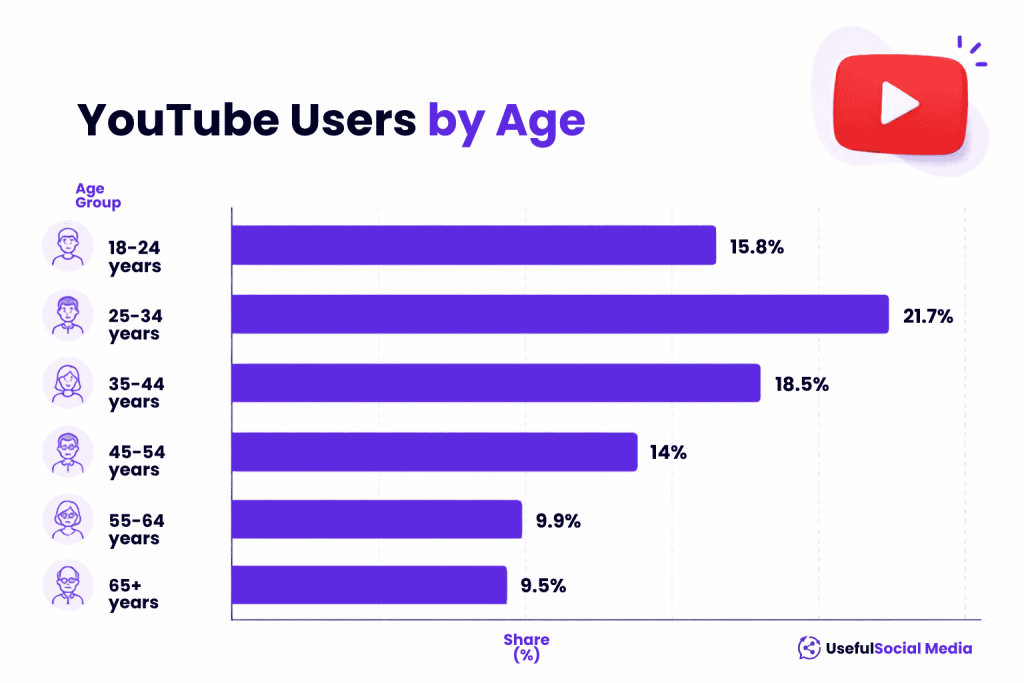
The table below depicts the distribution of YouTube users by age group.
| Age Group | Share |
|---|---|
| 18-24 years | 15.8% |
| 25-34 years | 21.7% |
| 35-44 years | 18.5% |
| 45-54 years | 14% |
| 55-64 years | 9.9% |
| 65+ years | 9.5% |
Source: DataReportal
YouTube Users by Gender
Men outnumber women by a slight margin in YouTube usage. The table below presents the distribution of YouTube users by gender.
| Gender | Share |
|---|---|
| Male | 53% |
| Female | 47% |
Source: DataReportal
YouTube Engagement Statistics
User counts tell you reach. Engagement data tells you where attention and advertising value actually concentrate, and the numbers here often differ from the user rankings.
YouTube Traffic Share by Country
The United States sends 21.29% of YouTube’s traffic despite having half of India’s user base, while India contributes just 5.46%.
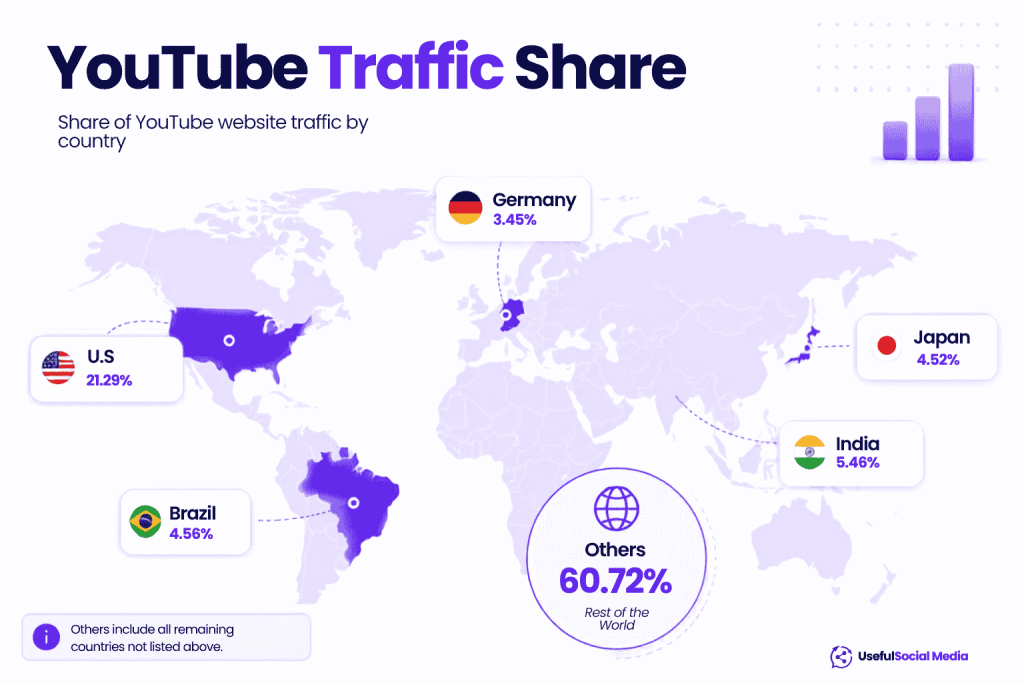
That gap points to spending power and watch habits. American viewers and advertisers generate far more measurable value per person, which is why US ad rates stay high even in a smaller market.
| Country | Traffic Share | Monthly Change Rate |
|---|---|---|
| United States | 21.29% | ↑6.33% |
| India | 5.46% | ↑6.51% |
| Brazil | 4.56% | ↑2.64% |
| Japan | 4.52% | ↑9.31% |
| Germany | 3.45% | ↑5.48% |
| Others | 60.72% | – |
Source: Similarweb
Engagement by Device
Device data shows how people reach the site rather than the app, so the split below reflects web browser visits.
| Device | Share |
|---|---|
| Desktop | 77.22% |
| Mobile | 22.78% |
Source: Similarweb
How This Data Can Help Creators & Business Owners
From the data, creators and business owners can perform the following actions:
1. Price ads by traffic, not subscribers: The US drives around 22% of YouTube’s traffic, whereas India only drives 5.46%. So charge higher rates for audiences from the US and Germany, even if most of your subscribers are from other countries.
2. Build for desktop first: 77.2% of YouTube’s web traffic comes from desktop. So design CTAs and landing pages accordingly.
3. Focus on growth: India, Indonesia, and the Philippines all have a penetration rate of under or near 50%. Millions of new users are still coming online. Building a presence there now, even through collaborations or locally relevant content, gives you a head start before those markets get crowded.
4. Add subtitles: India and Brazil alone account for 635 million users. You can translate your existing videos into their native languages, like Hindi, Portuguese, and other languages. This is the easiest way to reach new audiences without creating any new content.
Conclusion: India leads the world in YouTube users, with approximately 491 million users
India has more users than any other country, but its low penetration rate means there’s still huge room for growth ahead.
Meanwhile, the United States and Germany have already matured. There aren’t many new users left to sign up, but people who are on YouTube spend more time on it, and advertisers pay more.
So, if you’re a creator or a brand, the strategy is simple. Chase scale in emerging markets like India, and chase watch time in saturated ones.
FAQs
Germany has the highest YouTube penetration rate in the world, with 77.6% of its population using the platform. That means nearly four out of five Germans are on the platform, the highest rate you’ll find among the top ten countries
India has a massive population, so even though there are 491 million internet users, that’s just about a third of the country. There’s still a huge group of people who haven’t come online yet, which means there’s plenty of room for growth as internet access continues to reach more areas.
The United States has a 21.29% traffic share. It leads in engagement value even though India has more total users.
Yes. Viewers aged 18 to 34 make up more than half of all users, making it a strong fit for content aimed at younger audiences.